The Hollywood Reporter: Donald Trump Tries Movie Tariff Saber-Rattling Again
Days before a government shutdown deadline, Donald Trump is raising the vague, if consequential, specter of a "100%" tariff aimed at Hollywood's feature film development pipeline.
"Our movie making business has been stolen from the United States of America, by other Countries," the president wrote Monday on his Truth Social platform, adding a few digs at California Gov. Gavin Newsom before getting to the point: "I will be imposing a 100% Tariff on any and all movies that are made outside of the United States."
If this sounds familiar, it was just months ago in May that Trump issued what sounded like a bombshell: All movies that would be "made" outside the country would be subject to a tariff. Viewed along with the president's rollout of his tariffs on dozens of countries, it felt like an ominous move that would throw co-financing, co-production and development into disarray.
Since that time, more context about what prompted the original tariffs missive - a Mar-a-Lago meeting with his Hollywood ambassador Jon Voight and his business partner Steven Paul, for one - has added nuance to the narrative. Voight and Paul, for example, formally unveiled what they described as a Trump-friendly blueprint to the president as of May 5. That plan mentioned "federal tax incentives, significant changes to several tax codes, the establishment of co-production treaties with foreign countries, and infrastructure subsidies for theater owners, film and television production companies, and post-production companies."
Notably, the only mention of tariffs in Trump's own Hollywood adviser's plan was a line that read, "The proposal also includes a focus on job training, and tariffs in certain limited circumstances." (Also, the meaning of "made" is vague - does that mean on-location shooting? Postproduction? Getting to any definition of "made" may render the conversation about what features get a "100% tariff" moot, features are global products with thousands of workers on them in many locations. After Trump's note, Newsom's press office published a post reading, "Today's move is 100% stupid.")
Since the president's original comments, attention has shifted from tariffs to the idea of what a federal tax incentive from Congress could look like to encourage productions to shoot in the U.S. versus cheaper locales abroad. But the idea that legislators could make progress on this issue in the near-term seems unlikely given Democrats and Republicans are hurtling toward a federal government shutdown on Wednesday if the Senate can't agree on a funding bill that gets 60 votes. Hollywood is, lets say, not at the top of mind at the moment on Capitol Hill as a blame game gets ready to start over the government shuttering.
Tax credits talk, not tariffs, is the language that the industry is familiar with. There's an ever-escalating race for states (and countries) to compete to offer the best value for productions. That was part of the reason why Newsom pushed an effort to double California's annual tax credit program from $330 million a year to $750 million a year - it's facing tough competition from New York, New Jersey, Georgia, New Mexico and other states, not to mention the U.K., where multiple major studios have large production hubs, as well as Canada and Australia.
As far as how the global race for Hollywood projects is going, the United States saw $7.2 billion in production spend on 216 projects in the first half of 2025, per a report from industry tracker ProdPro that looked at projects that had a budget greater than $10 million. The U.K. saw $4 billion in production spend on 118 projects, while Canada saw $2.3 billion on 91 projects and Australia booked $1.1 billion on 30 projects in the first half of 2025. All of those countries, except for Australia, saw year-over-year spend declines. In the U.S.' case, it's at -27 percent from the comparable period, the first half of 2024.
The president's efforts to tap into protectionist point of view for Hollywood - with the caveat being that it's on his terms - arrives on the heels of industry advocates already doing the same.
Shoot days in Los Angeles have notably declined across feature films and television series as studios cut the number of theatrical bets they make and trim episode counts of shows. Efforts like "Stay in L.A." have pressured state and local officials to make shooting in Hollywood's historic production hub more efficient and politicians like L.A. Mayor Karen Bass have pledged to do more to make it easier to shoot locally.
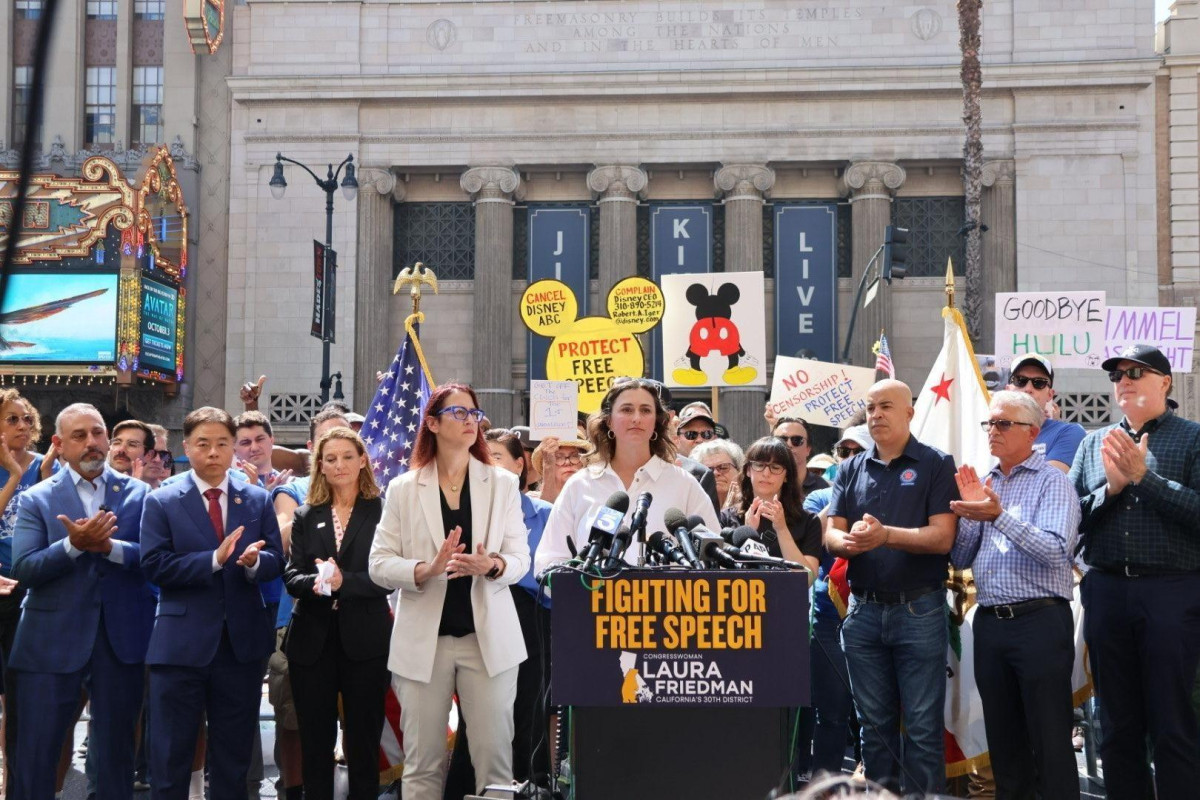
To that end, Congresswoman Laura Friedman, who reps the studio hub of Burbank, reiterated her support of a federal incentive on Monday in reply to Trump's post: "I'm relieved President Trump recognizes that we are losing a signature American product: the domestic film & TV industry. However, his 100% tariff on foreign films will raise costs for consumers. As the representative of nearly every major producer in Hollywood and a former film producer, I know what will work, without harming consumers: a national film tax credit."
Sen. Adam Schiff added on Monday, "We have an opportunity to pass a major federal film tax credit. I'm ready to work with this administration and my colleagues on both sides of the aisle to get it done."
The White House's go-between Paul, in a September interview with The Hollywood Reporter, described the president's attention on the industry as ultimately beneficial versus a punitive measure: "[Trump] loves the entertainment business, and it's not a Democrat or Republican business." The manager, a producer behind the Baby Geniuses franchise, recently bought Avenue Six Studios in Van Nuys, a facility with four soundstages. He is also shooting his latest project The Last Firefighter, starring Voight and Kelsey Grammer, in California despite costs being higher to shoot in the state.