New York Times: As L.A. Counts Ballots in a Glass Room, Officials Invite Anyone to Watch
As California vote counts go, this year should have been a snoozer. The statewide ballot had only one question, on whether to authorize the legislature to redraw the state’s congressional districts, and polls had been forecasting an easy passage for months.
In the sprawling facility where Los Angeles County processes its ballots, however, the floor was alive with watchful eyes on Tuesday — the result of an announcement that the Trump administration had dispatched monitors from the Department of Justice to observe the vote count.
The public has long been welcome to watch the ballot counting process. But the Justice Department’s announcement spurred fresh interest in observing the count among political activists and public officials, as well as among Democrats hoping to monitor the Republican monitors.
By early evening, at least one Democratic member of Congress from the Los Angeles area, Representative Laura Friedman, had stopped in for a prearranged tour of the building. Representatives of the campaign to pass the ballot initiative had checked in, as had a local Republican activist, a staff member for a local Democratic legislator, representatives of a Los Angeles nonprofit and two election lawyers.
Several representatives of the California attorney general’s office had dropped by to ask whether the federal monitor had arrived yet.
He had not.
Shortly after the polls closed at 8 p.m., the Associated Press declared that the measure had passed.
But there had been no sign of the Justice Department lawyer, who election officials had been told would be visiting to look for signs of voter fraud and intimidation.
As Californians voted on Proposition 50, which asked them whether the Democratic-led state should redraw its congressional maps to counter recent redistricting to favor Republicans in states like Texas, President Trump reiterated his view, without evidence, that the election was rigged.
“The Unconstitutional Redistricting Vote in California is a GIANT SCAM in that the entire process, in particular the Voting itself, is RIGGED,” Mr. Trump wrote in a morning social media post. “All ‘Mail-In’ Ballots, where the Republicans in that State are ‘Shut Out,’ is under very serious legal and criminal review. STAY TUNED!”
In fact, in Los Angeles County, more than 1.4 million mail-in ballots, cast by voters of all parties, were already waiting to be counted when Mr. Trump posted, along with about 200,000 ballots from people who had voted in person so far. Since the pandemic, the majority of Californians have voted by mail.
About 5.8 million Californians are registered to vote in Los Angeles County. Dean Logan, the registrar-recorder, predicted that turnout would approximate the attempt to recall Gov. Gavin Newsom in 2021, when about 52 percent of registered voters cast votes. By evening, long lines had formed outside polling places, and turnout appeared on track to perhaps exceed the recall turnout.
“It’s unfortunate that on Election Day we have a narrative out there that is distracting people from the importance of their vote,” Mr. Logan said. “The reality is that California and L.A. County have shown over and over again that the voting process is secure.”
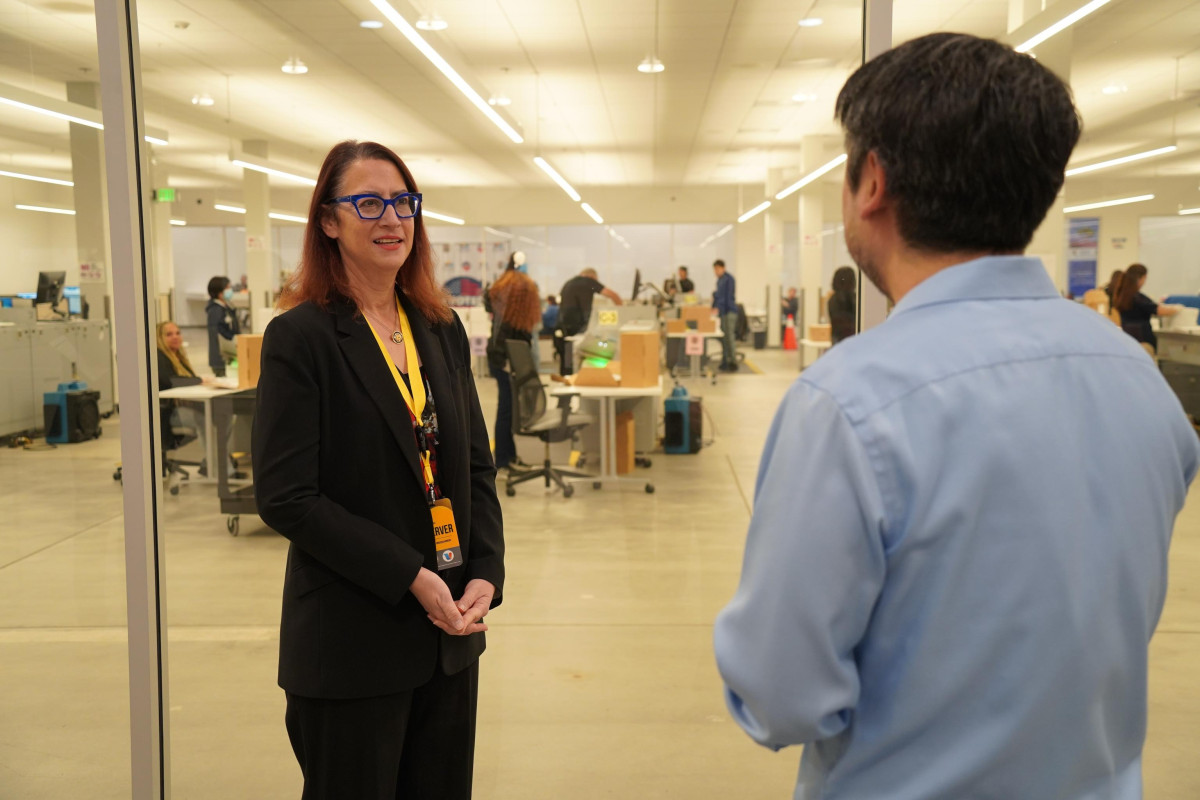
Los Angeles County last year opened a 144,000-square-foot ballot processing center east of downtown, in the San Gabriel Valley. It was equipped with what Mr. Logan and his staff said was state-of-the art equipment and security. On Tuesday, specially trained dogs sniffed boxes of ballots for explosives and contraband as they were unloaded from mail trucks.
Ballots have been going through preliminary processing for weeks. Voters in the county, which stretches over more than 4,000 square miles, from the high desert to Santa Catalina Island off the coast, were able to deposit their ballots at 251 drop boxes.
Election officials, working in pairs, regularly moved the ballots in sealed containers to the processing center. Law enforcement officers escorted boxes of in-person votes.
Those ballots, as well as those sent in by mail, were opened by machine and scanned to ensure the signatures on the envelopes matched the digital signatures on file for each voter.
On Tuesday, surveillance cameras on the building’s ceiling were livestreaming various parts of the process.
Workers sat in long rows extracting verified mail ballots from their envelopes and sorting them into colored boxes — green for ready to go, yellow for ballots too stained or torn to be easily fed into the tallying machinery, red for ballots with too many marks, questionable signatures or other issues that might render them invalid.
No writing implements were allowed in the sorting area, save for gold pencils to mark ballots that required further examination. No backpacks or bags or drinks could be at the desks. Every few hours, to remain alert, the whole room stood to perform mild calisthenics — scores of county workers in sweaters and T-shirts did arm circles and leg lifts together before resuming their jobs.
County workers on Tuesday were buzzing about a special mission over the weekend: a frantic voter had called the county’s toll-free hotline, reporting that he had accidentally deposited his rent in a dropbox instead of his ballot. Poll workers had adjusted their pickup route to help him retrieve it — an envelope with $1,500 cash.
Voters lined up at a polling site in Hacienda Heights, Calif., on Tuesday.Credit...Philip Cheung for The New York Times
At the polls, where in-person voting began on Oct. 25, concern about the possibility of intimidation by armed federal agents or other disruptions ran high. On Election Day, early reports from voting rights groups that staffed voter protection hotlines and had observers at the polls indicated that no such incidents had surfaced.
One of the main concerns came from voters confused about where to vote because previous polling sites in some counties had been eliminated, according to Ariana Marmolejo, a spokeswoman for the voter protection group Common Cause. “It was pretty much a typical election,” she added.
This year, L.A. county officials said, the troubleshooting teams that usually responded to jammed voting machines and power disruptions now included representatives of the county’s Human Relations Commission who were specially trained to de-escalate conflict.
The floor of the vote processing building itself was transparent, with air-gapped glass walls separating rows of industrial-sized counting machines from the rest of the operation. The glass counting room had no internet access or landlines to protect the count from cyber-intrusions, officials said, and it was equipped with backup generators to ensure that the count would continue even if the power goes down.
At 8 p.m., as election workers watched, the first 1,484,190 votes were tabulated, with more in the pipeline. And while visitors had a view of every part of the vote count, they could not bring in bags, cameras or other equipment or leave a designated viewing area without an escort.
“I hope that we can get beyond the noise and remind voters that this process belongs to them,” Mr. Logan said.